
Replicability Prediction
Replicability matters, but judging it has traditionally been more art than science. ReviewerZero's Replicability Prediction transforms curated criteria into a transparent, quantified assessment that helps you strengthen your research before submission.
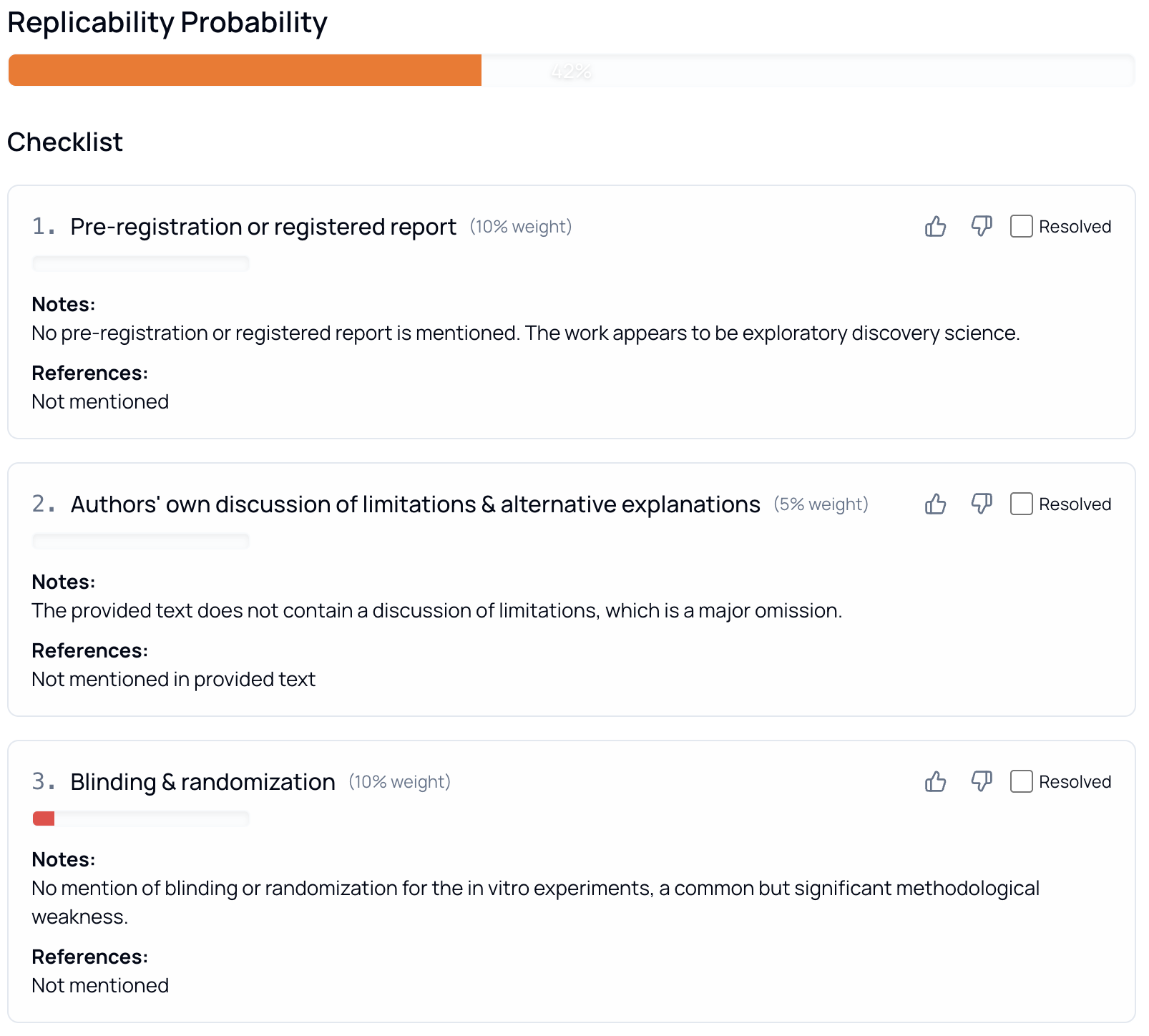 Replicability Assessment
Why Replicability Prediction?
The replication crisis has highlighted serious concerns across scientific disciplines:
- Many published findings fail to replicate
- Reviewers struggle to consistently assess replicability
- Authors may not know which factors most affect reproducibility
- Journals increasingly require transparency and rigor
Our system provides an objective, criteria-based assessment that helps identify weaknesses before they become problems.
What We Evaluate
The system assesses multiple factors that research has shown to predict replicability:
| Factor | Description |
|---|---|
| Sample Size | Is the sample adequate for the claims being made? |
| Data Transparency | Are data, code, and materials available? |
| Methodological Rigor | Are methods described in sufficient detail? |
| Statistical Practices | Are appropriate analyses used and reported correctly? |
| Pre-registration | Was the study pre-registered? |
| Effect Size Reporting | Are effect sizes reported with confidence intervals? |
| Power Analysis | Is statistical power addressed? |
How It Works
Criteria-Based Assessment
Each factor is evaluated against established best practices:
- Text analysis - The system scans your manuscript for relevant statements
- Evidence extraction - Specific passages are identified that support or undermine each criterion
- Scoring - Each factor receives a score based on available evidence
- Aggregation - Individual scores combine into an overall prediction
Transparent Scoring
Unlike black-box predictions, our system shows:
- Overall probability - The predicted likelihood of successful replication
- Factor breakdown - How each criterion contributes to the score
- Evidence citations - Specific passages from your manuscript
- Improvement areas - Clear recommendations for strengthening your research
Understanding Results
Replicability Score
The overall score represents the predicted probability of successful replication:
| Score Range | Interpretation |
|---|---|
| 80-100% | Strong replicability indicators |
| 60-79% | Good, with room for improvement |
| 40-59% | Moderate concerns - review recommendations |
| 0-39% | Significant concerns - address before submission |
Factor Details
For each evaluated factor, you'll see:
- Status - Whether the criterion is met, partially met, or not met
- Evidence - Quotes from your manuscript supporting the assessment
- Recommendations - Specific actions to improve this factor
- Weight - How much this factor affects the overall score
Interactive Checklist
The system provides an interactive checklist where you can:
- Track which criteria you've addressed
- Click any item to highlight its supporting evidence in the PDF
- Dismiss items that do not apply, with one-click restore
- Find replicability findings included in the full report download
Common Issues
Sample Size Concerns
- Sample too small for claimed effects
- No power analysis or justification provided
- Subgroup analyses with inadequate n
Transparency Gaps
- Data not shared or availability unclear
- Code/materials not provided
- Pre-registration not mentioned
Methodological Issues
- Insufficient detail to replicate procedures
- Missing important control conditions
- Unclear exclusion criteria
Statistical Practices
- P-values without effect sizes
- Multiple comparisons without correction
- Selective reporting indicators
Improving Your Score
Quick Wins
- Add a data availability statement
- Report effect sizes with confidence intervals
- Include power analysis or sample size justification
- Clarify your pre-registration status
Deeper Improvements
- Expand your methods section with replication-enabling detail
- Share code and materials in a repository
- Address alternative explanations
- Report all conducted analyses
Best Practices
Before Running Assessment
- Ensure your manuscript is near-final
- Include all relevant methods details
- Add data/code availability statements
Interpreting Results
- Use the assessment as a guide, not a guarantee
- Consider discipline-specific norms
- Prioritize factors most relevant to your research type
- Discuss results with co-authors
After Assessment
- Address high-impact factors first
- Re-run the assessment after revisions
- Document your improvements
- Consider reviewer perspective
Limitations
What This Is Not
- A guarantee - High scores don't guarantee replication
- Field-specific - Some criteria may be more relevant in certain disciplines
- Complete - Not all replicability factors can be assessed from text alone
Context Matters
Some legitimate research may score lower due to:
- Exploratory or hypothesis-generating studies
- Resource constraints that limit sample sizes
- Novel methods without established practices
- Confidential data that cannot be shared
Related Resources
- AI Review - Structured peer-review feedback
- Statistical Checks - Verify reported statistics
- Guideline Compliance - Meet journal requirements