
Citation Analysis
ReviewerZero's Citation Analysis feature automatically verifies citations against major academic databases to ensure accuracy and completeness. Our system helps detect fabricated, incorrect, or out-of-context references that could compromise scientific integrity.
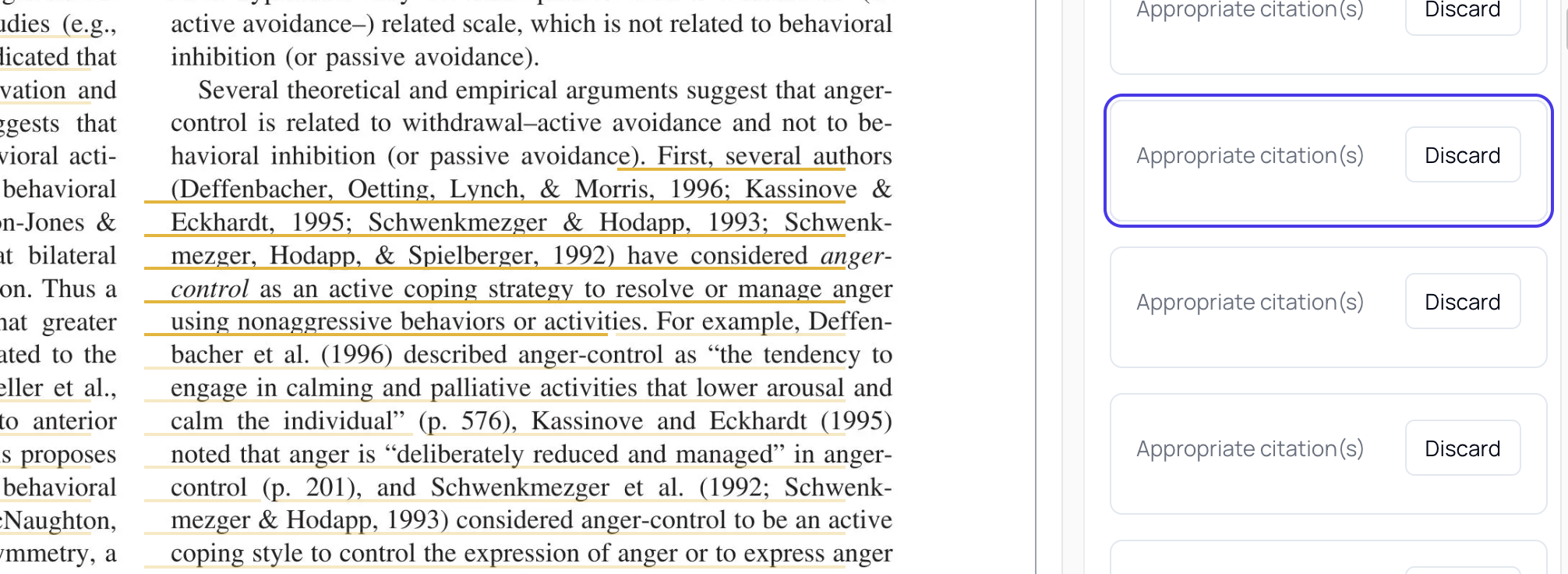 Citation Check In Context
Why Citation Analysis Matters
Proper citation is fundamental to scientific integrity. Citation issues can range from innocent mistakes to deliberate manipulation:
- Transcription errors in DOIs or page numbers
- Missing references to relevant prior work
- Citation of retracted papers without acknowledgment
Our automated system catches these issues before they become problems in peer review or post-publication.
What We Check
Reference Accuracy
Every citation is verified against authoritative sources:
| Check | Description |
|---|---|
| DOI Validation | Verify DOIs are registered and resolve correctly to the cited paper — including repair of DOIs corrupted during PDF processing and support for CNKI/ISTIC (Chinese) DOIs |
| Metadata Match | Confirm author names (including a swapped lead author), titles, venues, and publication details |
| Volume & Page Numbers | Check that volume and page ranges are accurate |
| Publication Year | Verify dates match the source |
| Link Accessibility | Check that cited URLs resolve and are accessible |
| Preprint Status | Flag preprints cited where a published version exists |
Fabrication Detection
References that cannot be matched to any real publication are assessed for fabrication risk. The system searches multiple scholarly databases and the web, corroborates book references against library records, and reports a confidence-tiered verdict — so a likely hallucinated reference is flagged as such, not silently marked "not found".
Retraction Monitoring
Citations are checked for retraction status using OpenAlex metadata, and we alert you when a cited paper is marked retracted. References are also checked for discussion on PubPeer.
How It Works
Step 1: Reference Extraction
Our system automatically extracts all references from your manuscript:
- Parses reference lists in various formats
- Extracts in-text citations
- Links citations to their reference entries
Step 2: Database Lookup
Each reference is verified against multiple academic databases for DOI validation, comprehensive metadata, and retraction status.
Step 3: Analysis and Reporting
Results are compiled into an actionable report:
- Issues categorized by severity
- Direct links to problem citations
- Suggestions for corrections
- Context shown in the original document
Understanding Results
Issue Categories
Every reference carries an explicit list of the issues found, each with a severity:
| Severity | Examples | Action Required |
|---|---|---|
| Red | Cited paper has been retracted; reference is likely fabricated; cited link is broken | Update or remove citation |
| Amber | Reference details don't match the source; preprint cited where a published version exists; citation doesn't support the claim it's attached to | Review and correct |
| Green | Reference verified | None |
Suggested Corrections as Tracked Changes
When a reference's details don't match the authoritative record, the card shows the correction inline as a tracked-change edit — the manuscript's text with the differing parts struck through and the verified values marked in — so you can see exactly what to fix at a glance. This covers titles, authors (including author order), venues, years, volumes, and pages.
In-Context Display
Issues are highlighted directly in your manuscript view:
- Click on any flagged citation to see details and jump to its location
- View the original reference entry and its citation contexts
- Access the source document when available
- See suggested corrections
Best Practices
Before Submission
- Run citation analysis on your final draft
- Address all critical and error-level issues
- Review warnings and make judgment calls
- Update any citations to retracted papers
Reference Management
- Use reference management software (Zotero, Mendeley, EndNote)
- Import references directly from databases when possible
- Verify DOIs are included for all references
- Keep your reference database updated
Avoiding Common Issues
DOI Problems
- Always include DOIs when available
- Verify DOIs resolve correctly before submission
- Use the official DOI format (https://doi.org/...)
Author Name Variations
- Use consistent author name formats
- Check for special characters and diacritics
- Verify author order matches the source
Journal Abbreviations
- Use standard journal abbreviations
- Be consistent throughout your reference list
- Check against official abbreviation lists
Integration with Other Features
Citation Analysis works alongside other ReviewerZero features:
With AI Review
The AI Review feature considers citation quality as part of its overall assessment:
- Flags potentially missing citations
- Identifies areas where additional references would strengthen arguments
- Suggests relevant literature you may have missed
Related Resources
- AI Review - Comprehensive manuscript feedback
- Statistical Checks - Verify reported statistics
- Author Verification - Confirm author credentials