
Author Verification
ReviewerZero's Author Verification feature uses AI-powered analysis to verify the identity and credentials of academic authors. By cross-referencing real-time web search results, publication records, and institutional data, we help detect potential authorship integrity issues.
Why Author Verification?
Authorship integrity is increasingly challenged by:
- Fabricated authors - Entirely fictional individuals listed as contributors
- Affiliation mismatches - Authors claiming affiliations they don't have
- Identity fraud - Authors misrepresenting their credentials
Our verification system helps identify these issues before they become problems.
Author Overview
Start with a clear overview of all authors in the manuscript. Our system presents author information in an easy-to-review format.
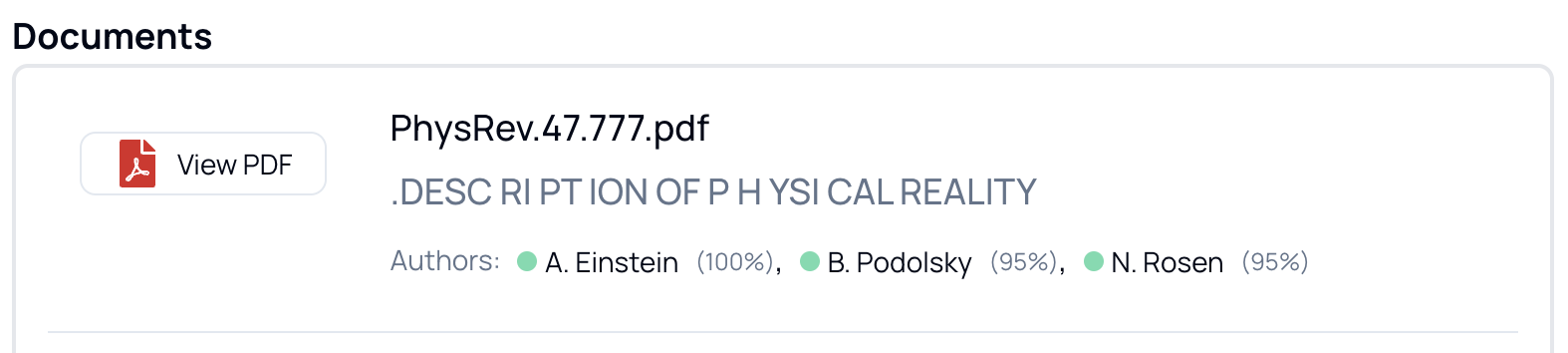 Author Verification List
What We Display
For each author, you'll see:
- Name as listed in the manuscript
- Claimed affiliations
- Verification status indicator
- Confidence score
- Quick action buttons
Verification Process
How We Verify Authors
Our AI analyzes multiple data sources to verify each author:
| Source | What We Check |
|---|---|
| Publication Databases | Academic publication records and researcher identifiers |
| Institutional Directories | University faculty pages, department listings |
| Professional Profiles | Academic profiles and institutional websites |
| Real-time Web Search | Current online presence and recent activity |
Verification Outcomes
Verified Authors
For legitimate authors, get detailed verification results and insights.
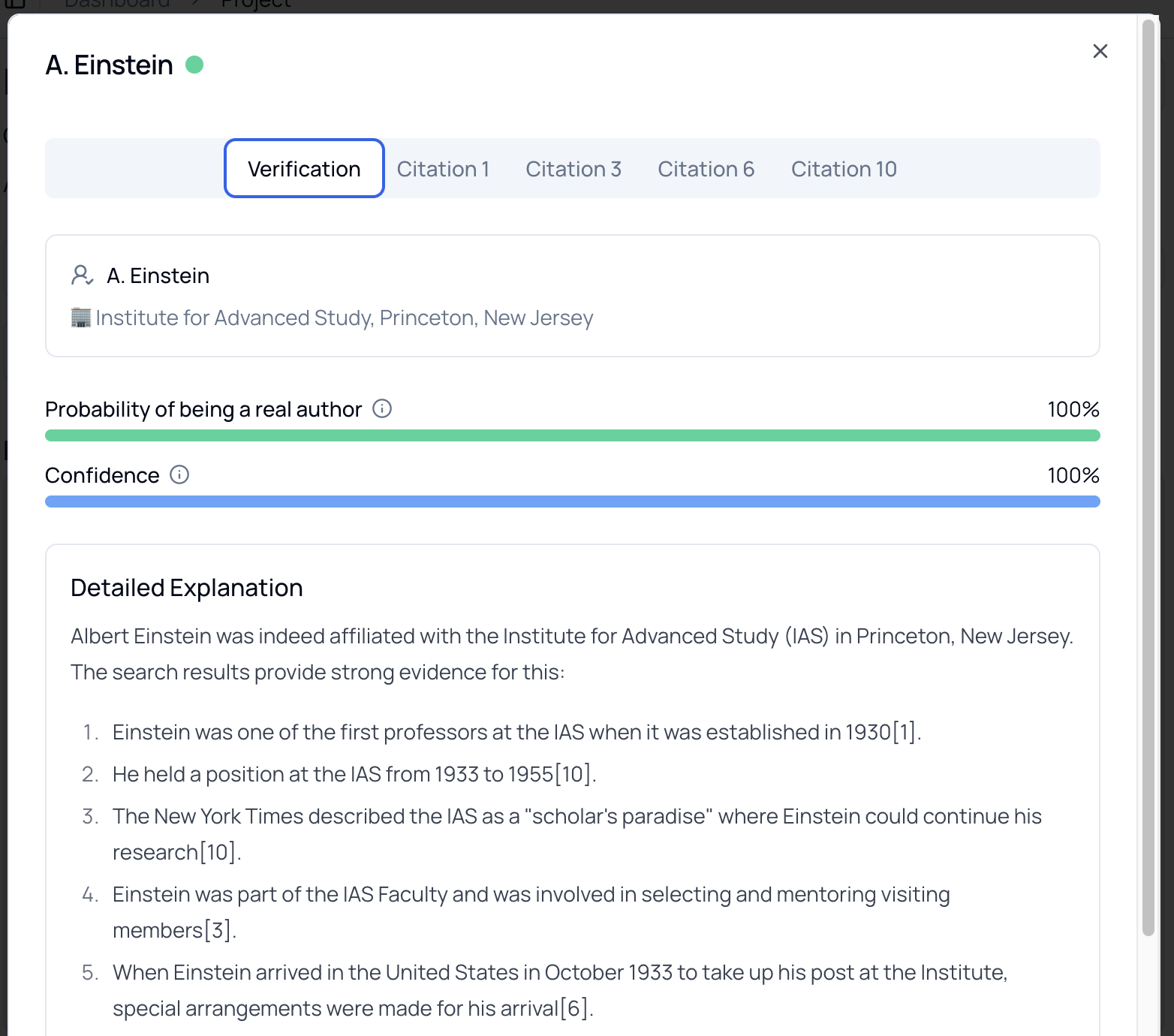 Verified Author Details
Verified authors show:
- Matching publication history
- Confirmed institutional affiliation
- Consistent research areas
- Linked ORCID or other identifiers
Flagged Authors
When authors cannot be verified, the system provides clear explanations.
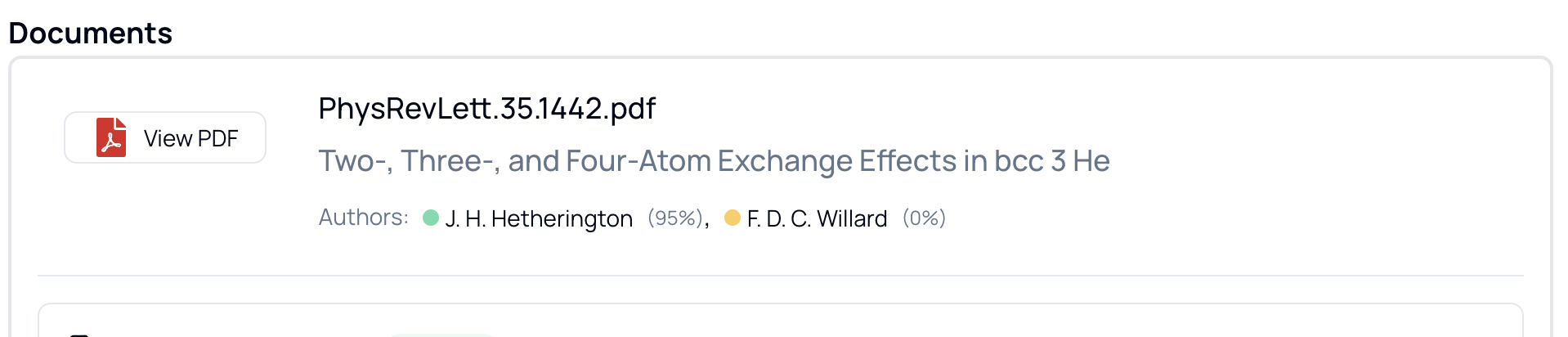 Author Issue Detection
Potential issues that trigger flags:
- No matching records in academic databases
- Affiliation doesn't match any known institution
- Name variations that don't resolve to a real person
- Inconsistent publication history
Issue Details
Get clear explanations when authors cannot be verified. Understand exactly why an author entry has been flagged as suspicious.
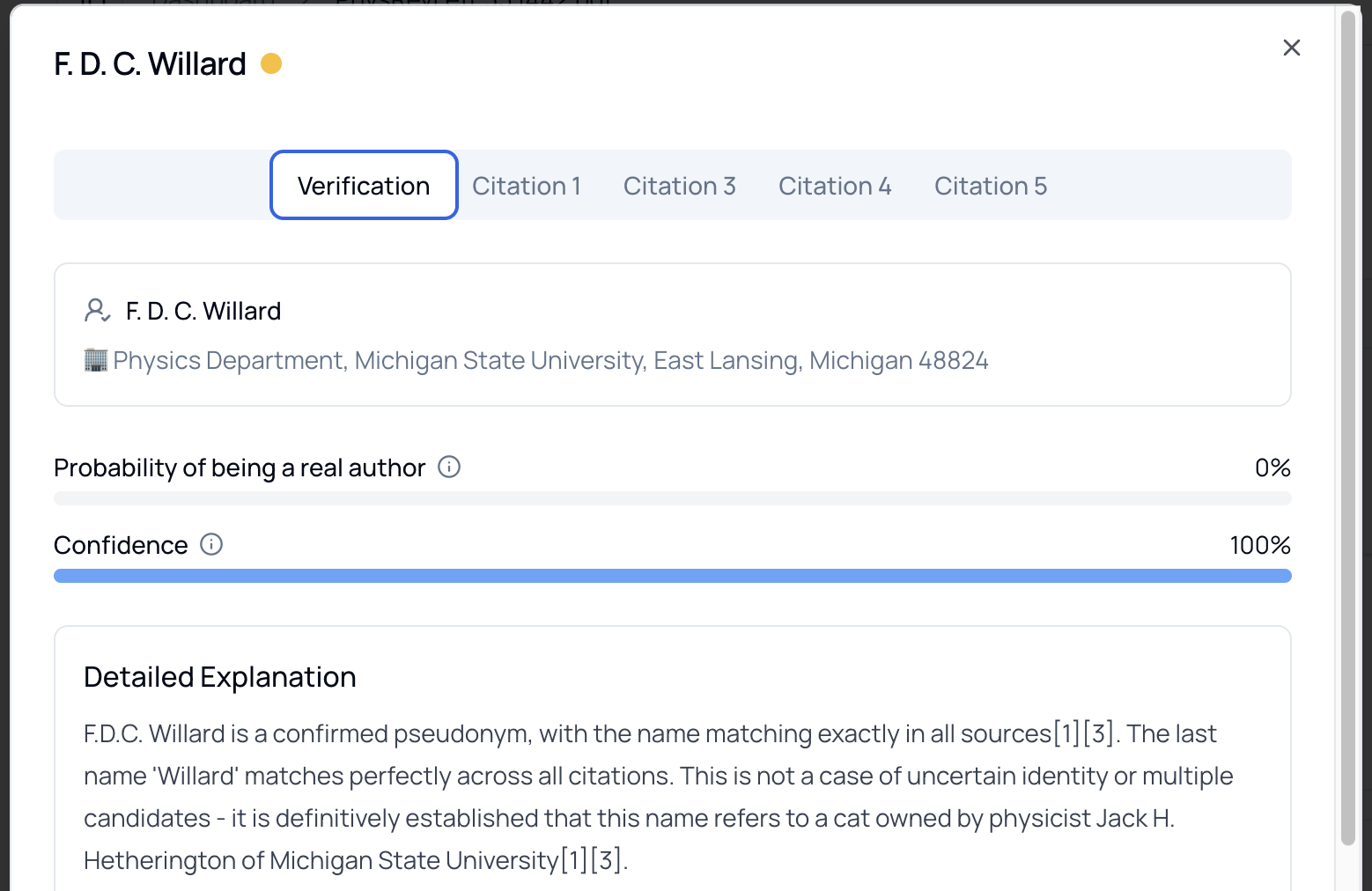 Issue Explanation
Detailed Analysis
For each flagged author, we provide:
- Search Results Summary - What databases were checked and what was found
- Affiliation Analysis - Whether the claimed institution exists and employs the person
- Publication Check - Whether prior publications can be attributed to this author
- Confidence Assessment - How certain we are about the finding
Possible Explanations
Not all flags indicate misconduct. Common legitimate explanations include:
- Early-career researchers with limited publication history
- Authors from institutions with limited online presence
- Name changes (marriage, etc.)
- Common names requiring disambiguation
Supporting Evidence
Access supporting evidence and citations that help validate or question authorship claims.
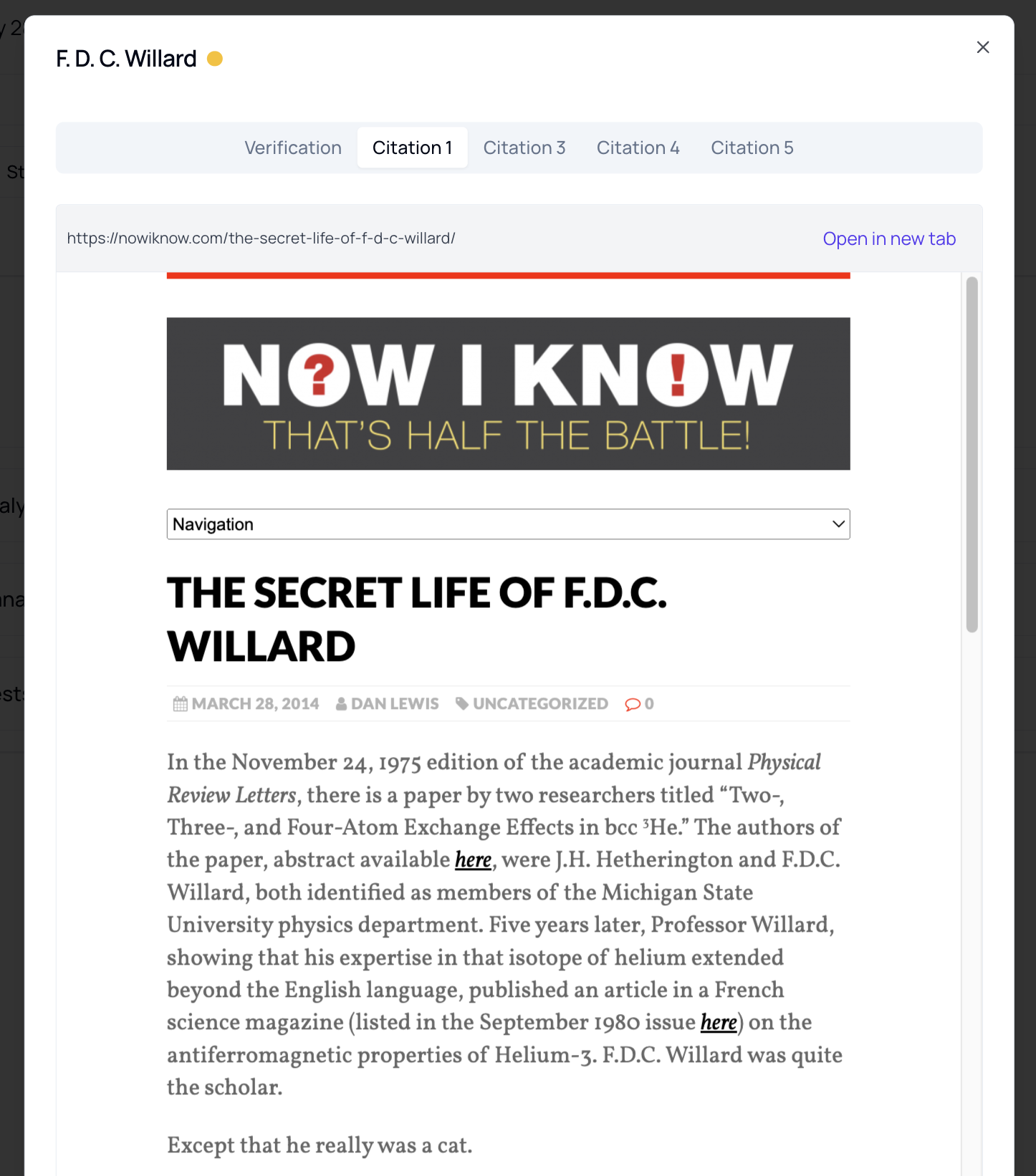 Supporting Evidence
Evidence Types
| Evidence | Description |
|---|---|
| Database Records | Links to entries in academic databases |
| Institutional Pages | Faculty directories, department listings |
| Prior Publications | Papers previously published by this author |
| Co-author Networks | Other researchers who have collaborated with this author |
Cross-Referencing
Cross-references author names accounting for Unicode and diacritic differences and common first-name variants. Non-Latin names require exact full-name matches.
What We Detect
Fabricated Authors
Red flags for entirely fictional contributors:
- No online presence whatsoever
- Affiliations that don't exist or don't match
- Names that appear only on suspicious publications
- Email domains that don't resolve
Affiliation Issues
Problems with claimed institutional affiliations:
- Institution doesn't exist
- Institution exists but has no record of the person
- Department or position doesn't match claims
- Time period inconsistencies
Confidence Scoring
Each verification includes a confidence score:
| Score | Meaning | Recommendation |
|---|---|---|
| High (80-100%) | Strong evidence supports verification | No action needed |
| Medium (50-79%) | Some evidence, but incomplete | Consider follow-up |
| Low (20-49%) | Limited evidence found | Investigate further |
| Very Low (<20%) | Cannot verify author | Requires explanation |
Best Practices
For Publishers
- Run author verification on all submissions
- Follow up on low-confidence scores before acceptance
- Request ORCID identifiers from all authors
- Verify corresponding author contact information
- Document your verification process
For Institutions
- Include author verification in integrity screening
- Train staff on interpreting verification results
- Develop policies for handling flagged authors
- Maintain records of verification outcomes
For Authors
- Ensure your ORCID profile is up to date
- Use consistent name formats across publications
- Keep institutional affiliations current
- Link your publications in academic profiles
Integration with Editorial Workflow
Pre-Screening
Run author verification early in the submission process:
- Flag potential issues before peer review
- Request clarification from authors promptly
- Avoid wasting reviewer time on problematic submissions
Post-Acceptance Checks
Final verification before publication:
- Confirm all author information is accurate
- Verify any changes made during revision
- Ensure author statements are complete
Related Resources
- Citation Analysis - Verify references and detect manipulation
- AI Review - Comprehensive manuscript assessment
- Platform Features - Sharing and collaboration tools