
Journal Monitoring
ReviewerZero's Journal Monitor is a predictive tool that helps publishers and researchers identify potential integrity risks in academic journals before they become serious problems.
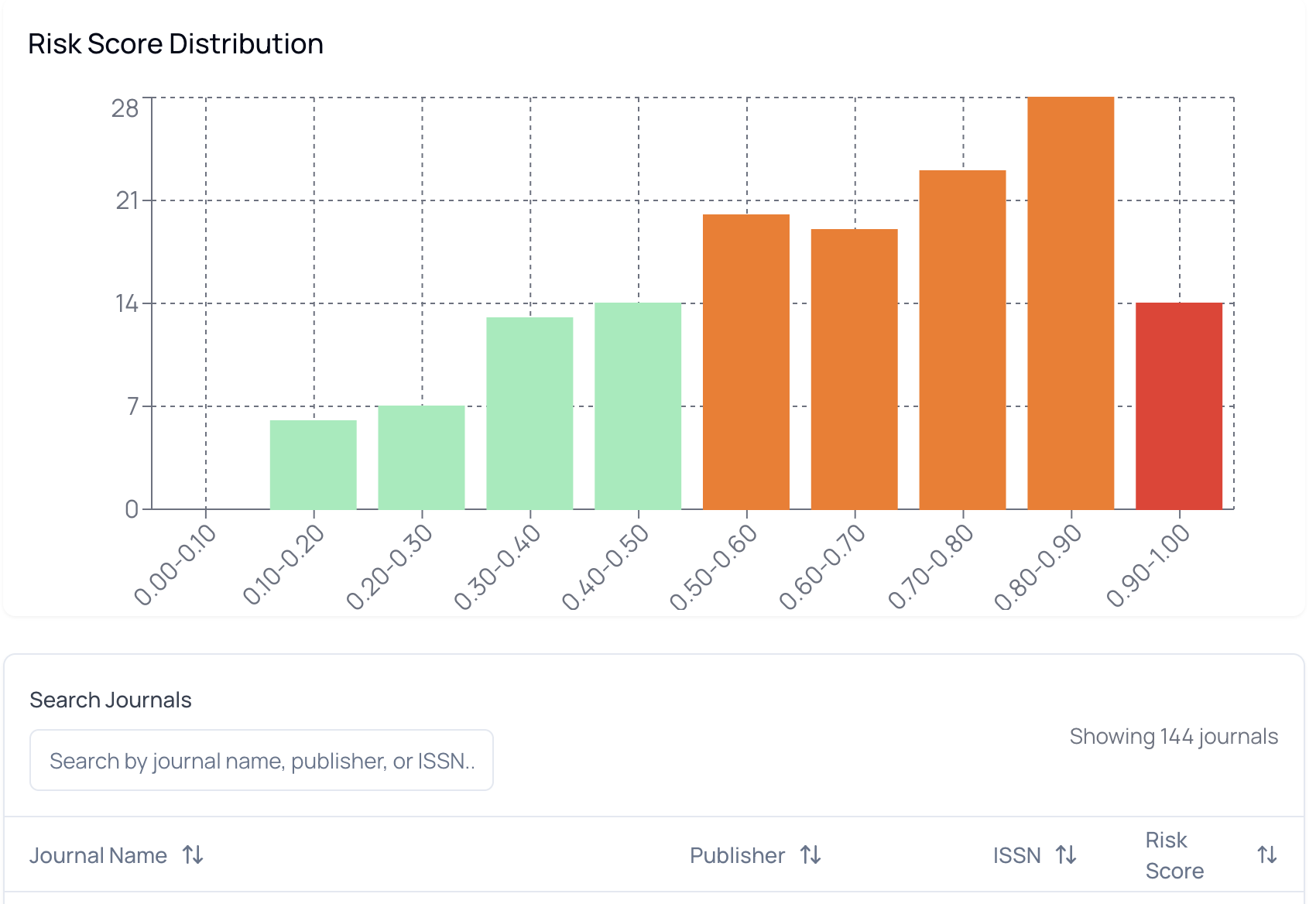 Journal Monitoring Dashboard
Preview / early access. Journal Monitoring is an early-access preview. The capabilities described on this page reflect planned functionality, and the live product currently displays demonstration data rather than a live analysis of your journals.
Why Journal Monitoring?
As a publisher, wouldn't it be good to know if one of your journals is at risk of being delisted from major databases? As an author, wouldn't it be good to know if a journal you're planning to submit to has a history of questionable practices?
The Journal Monitor is designed to surface journals showing potential red flags so that experts can investigate further. Live multi-journal analysis is in development, and the preview currently runs on demonstration data. This tool builds on methods developed in peer-reviewed research (Zhuang, Liang, and Acuna, 2025), which we are translating into an interactive platform for real-world use.
Key Benefits
- Early-warning signals for your journals
- React to changes before they become a problem
- Risk scoring methodology derived from peer-reviewed research, combining website, editorial, and bibliometric cues
- Triage-focused design to understand how you compare to others
What the Journal Monitor Examines
Editorial Board Composition
The tool analyzes a journal's editorial board to assess credibility:
| Check | What We Look For |
|---|---|
| Editor Credentials | Are editors recognized researchers with credible affiliations? |
| Board Diversity | Is there geographic and institutional diversity? |
| Duplicate Names | Are board members shared across multiple suspect journals? |
| Expert Recognition | Are advisors well-known in their fields? |
A journal whose board lacks recognized experts or lists many duplicate names across questionable journals raises a flag.
Citation Pattern Analysis
Unusual bibliometric trends provide important clues:
- Self-Citation Rate: Does a large fraction of articles cite the journal itself or a small group of authors repeatedly?
- Author Impact: What is the typical impact of authors publishing in the journal?
- Peer Comparison: How do citation patterns compare to similar journals in the field?
- Citation Networks: Are there unusual citation rings or patterns?
Website Design and Content Signals
The very look and structure of a journal's website provides hints:
Visual and Structural Analysis
- Template Detection: Is the site a generic template reused across multiple questionable publishers?
- Professional Design: Does the site look legitimate and professionally maintained?
- Content Quality: Are there clear aims and scope, editorial policies, and ethical guidelines?
Required Content Checks
The monitor verifies the presence and quality of:
- Clear aims and scope statement
- Editorial policies and peer review process
- Ethical guidelines and misconduct policies
- Contact information and publisher details
- ISSN and indexing information
Absence or vagueness in these sections is a warning sign.
Journal Metadata and History
Basic facts about a journal contribute to the overall assessment:
| Factor | Consideration |
|---|---|
| Age | Very new journals aren't suspicious alone, but combined with other factors, they add concern |
| Publisher | Is the publisher reputable and established? |
| Indexing Status | Is the journal indexed in major academic databases? |
| Retractions | While our tool is predictive, retraction history provides additional context |
| DOAJ Status | Is the journal listed in the Directory of Open Access Journals? |
Risk Scoring
The risk scoring approach is a research-derived methodology designed to combine all factors into a comprehensive score:
The scoring methodology is grounded in peer-reviewed research. In the current preview, the live product displays demonstration data, so scores shown reflect example journals rather than a real-time assessment of your own titles.
Score Components
- Editorial Risk - Based on board composition and credibility
- Bibliometric Risk - Based on citation patterns and metrics
- Website Risk - Based on site design and content quality
- Metadata Risk - Based on journal history and indexing
Interpreting Scores
| Score Range | Interpretation |
|---|---|
| Low Risk | Journal shows no concerning patterns |
| Moderate Risk | Some factors warrant monitoring |
| High Risk | Multiple red flags present; expert review recommended |
| Critical Risk | Significant concerns across multiple dimensions |
Designed for Triage
The Journal Monitor is a screening tool meant to assist human experts—not an oracle that issues final judgments.
Workflow Integration
- Automated Screening: The monitor flags journals showing potential issues
- Expert Review: Librarians, editors, or integrity officers investigate flagged journals
- Action Decision: Based on investigation, appropriate action is taken
- Continuous Monitoring: Journals are tracked over time for changes
For Publishers
- Monitor your own portfolio of journals
- Identify titles needing attention before external parties notice
- Track improvements after implementing changes
- Benchmark against peer journals
For Researchers
- Check potential submission targets before submitting
- Avoid journals with integrity concerns
- Protect your reputation by publishing in credible venues
For Institutions
- Evaluate journals for promotion and tenure decisions
- Guide researchers toward reputable publication venues
- Monitor institutional publication patterns
Getting Started
- Access the Journal Monitor from your dashboard
- Search for journals by name, ISSN, or publisher
- Review the risk assessment and contributing factors
- Investigate flagged issues with the detailed breakdown
- Set up monitoring alerts for journals you track regularly
Best Practices
Regular Monitoring
- Review your journal portfolio quarterly
- Set up alerts for significant score changes
- Track trends over time, not just point-in-time scores
Investigation Protocol
When a journal is flagged:
- Review the specific factors contributing to the score
- Gather additional information from independent sources
- Consult with subject matter experts
- Document findings and decisions
- Take appropriate action based on evidence
False Positives
Some legitimate journals may trigger alerts due to:
- Being newly established (limited track record)
- Niche fields with naturally higher self-citation
- Regional journals with limited international visibility
Always investigate before drawing conclusions.
Related Resources
- AI Review - Get structured feedback on manuscripts
- Citation Analysis - Verify references and detect issues
- Author Verification - Confirm author credentials